

- This event has passed.
Laurel for Peace and Security in Ukraine
April 29, 2022 @ 8:30 am - 11:30 am
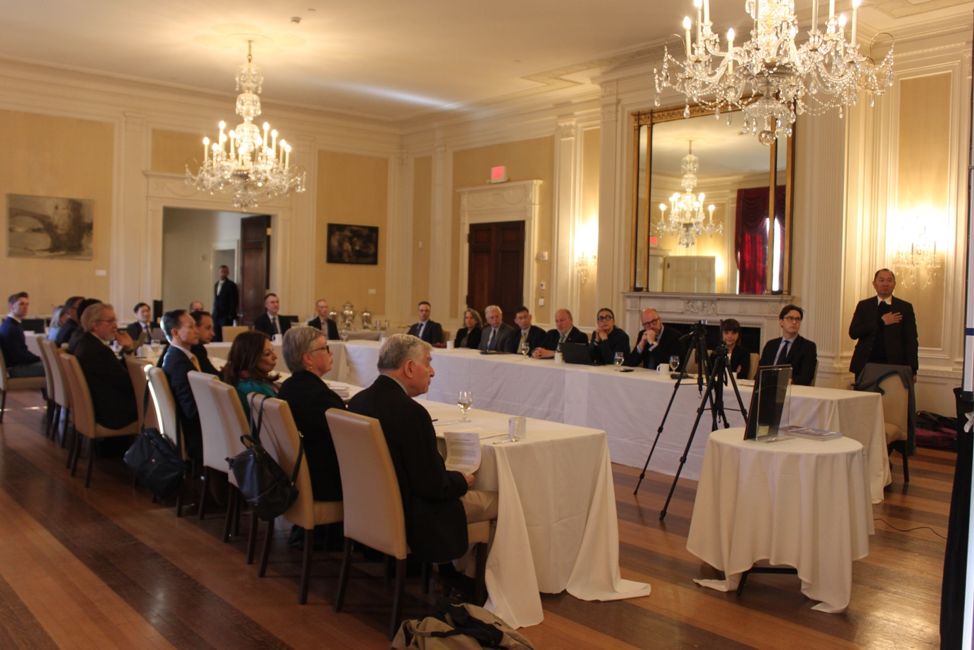
On April 29, 2022, world leaders convened at Loeb House, Harvard University, to discuss strategies for peace, security, and sovereign integrity of Ukraine. As Russia’s war against Ukraine continues, global leaders and diplomatic observers have turned their attention to two distinct agendas to help resolve the conflict. The first is to provide immediate support for Ukraine, as it endures unprecedented attacks by Russia, conducted with modern weapons and massive military power. The second involves planning for the prevention of unprovoked aggression through the adoption of values and standards that will ensure peaceful relations worldwide.
Short Term Strategies to Support Ukraine
Most immediate are the actions to support Ukraine and demonstrate the extent of global opposition to such aggression with indiscriminate violence. Bombing of urban civilian areas—apartment buildings, hospitals, schools, and farms—violates international law and norms of warfare agreed upon by the international community.
Participants in the Boston Global Forum Conference April 29, 2022 proposed the follow steps to assist Ukraine at this critical time of immense need:
- Provide humanitarian and other support to address the war-related health crisis in Ukrainian cities and towns. This includes medical supplies, health care providers, equipment, temporary hospitals, and all related assistance
- Deliver advanced weapons, offensive and defensive, to compensate for uneven scales in the war
- Share all intelligence information with the Ukrainian Government—including contributions by NATO and European nations—pertaining to Russian troop movements, tactical weapons locations, and battle plans;
- Sustain existing economic sanctions and impose sanctions to energy resources, which currently is the main financial source of support for Russia’s war machinery
- Support and engage in the debate on limitation and exclusion of Russia from the UN Security Council, as a country that fails to respect the UN Charter and its founding principles
- Provide strategic military advice to help in the fight against Russian air, ground, and naval forces
- Assist Ukrainian students and children in the country, who face shortages of basic needs such as food, shelter, and medical care. Assist in sustaining, where possible, educational institutions. Call on Ukrainian students outside the country to find ways to help and rebuild Ukraine.
- Call for organizing a High-Level International Conference on Peace, Security, and Territorial Integrity for Ukraine, with participations by leaders from Russia, Ukraine, United States, and the European Union, to be held in Paris, Riga, or Stockholm.
Long-term Strategies to Support Ukraine
The Ukraine invasion is a painful lesson for the world, that compromises with dictators and authoritarian regimes only feed aggression. In response, speakers at the Boston Global Forum focused on the advantages of promoting the development of a competitive economy, in conjunction with a flourishing democratic political system.
Above all, the war on Ukraine has highlighted ways in which the leaders of Russia deceive the public through their messages, actions, and the use of their propaganda systems. They promised to create “humanitarian corridors” to allow civilian non-combatants to leave areas under attack, only to renege on those promises. Russia has not made any serious attempt to engage in peace talks. All evidence so far is of hollow commitments.
Speakers at the conference underscored the need to address Russia’s aggression and its unprecedented disinformation by adopting specific steps:
- Promote shared democratic values through multilateral organizations, NGOs, universities, business entities, and academic centers;
- Develop a comprehensive, multinational, and novel form of Marshall plan for Ukraine to ensure fast reconstruction and recovery from the war. It will serve as a coordinated and efficient platform for economic development, social assistance, and human empowerment
- Develop legal and humanitarian standards as foundations for 21st century international relations. For example, the Social Contract for the AI Age and the book Remaking the World – Toward an Age of Global Enlightenment provide invaluable guidance for rational rulemaking in the Age of Digital and AI
- Encourage the formation of a New Alliance to protect rational standards and the security of countries that support them.